
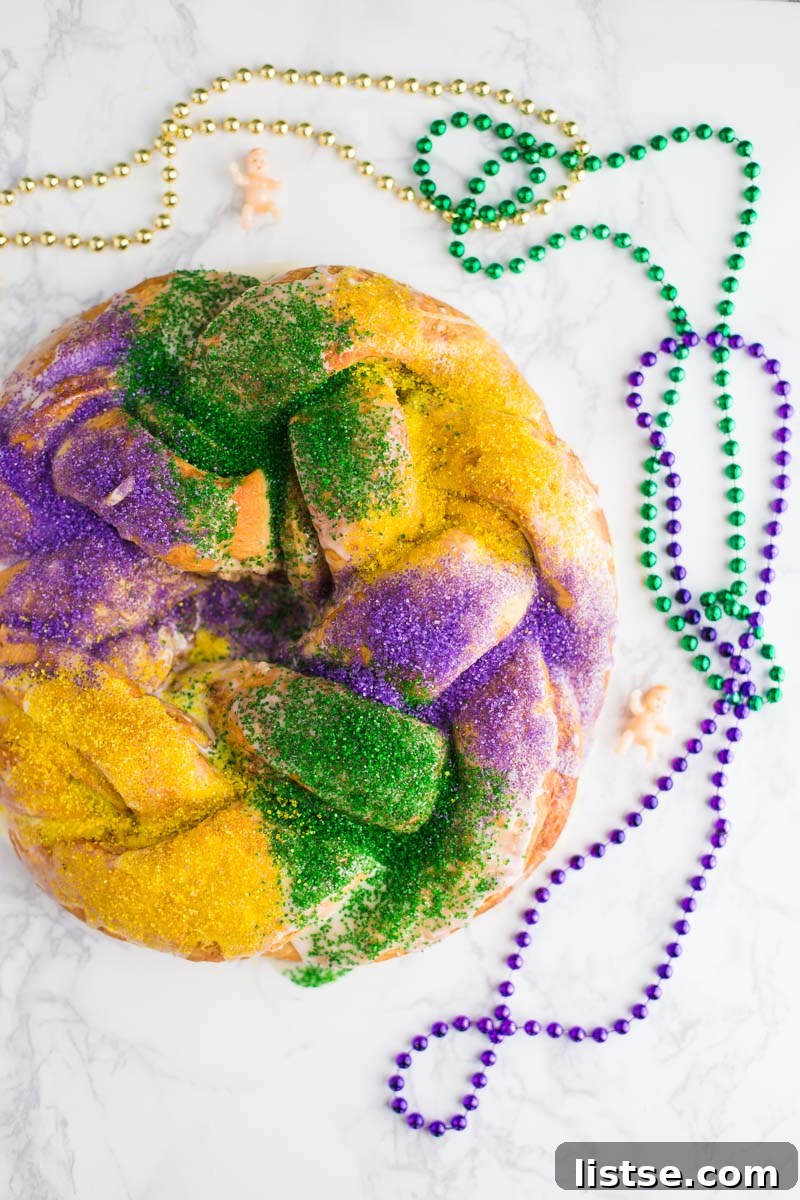
UPDATED RECIPE (March 1, 2019): After careful reviews of the original recipe and multiple retests, this Vegan King Cake recipe has been significantly updated and perfected. We are confident you will find this improved version even more delightful and easier to execute. Please share your feedback – we can’t wait to hear how much you love it!
Celebrate Mardi Gras with Our Authentic & Easy Vegan King Cake
For four long years, those quintessential plastic King Cake babies, essential for any proper Mardi Gras celebration, patiently waited in my overflowing blogging drawer. This whimsical drawer, a testament to countless creative projects, housed an eclectic collection: every shade of paper straw imaginable, vibrant tie-dye ice cream cones, and an abundance of wooden utensils that, to my slight embarrassment, had never once seen the light of a recipe. It became their temporary, yet persistent, home.
But this year, the promise was firm. Those adorable little babies were destined for their true purpose! And so, here we are, embracing the festive spirit of Mardi Gras with a homemade King Cake. The most exciting part? It’s completely and utterly **vegan!** This means everyone can partake in the joy and tradition of this iconic seasonal treat, without compromise. It’s a moment of immense satisfaction to finally bring this plant-based King Cake to life, especially for those who thought a vegan version might be out of reach.
The Simple Secret to a Sensational Vegan King Cake
Developing a vegan version of the classic King Cake proved to be surprisingly simple, a delightful discovery in the world of plant-based baking. Instead of complex adaptations, the process focused on straightforward, effective substitutions for traditional animal products. The goal was to maintain the cake’s signature rich flavor, tender crumb, and beautiful appearance, all while making it entirely suitable for a vegan diet. Here’s a breakdown of the key ingredient swaps that made this possible:
- Vegan Butter: The richness and moisture typically provided by dairy butter were perfectly replicated using Earth Balance vegan butter. This product is fantastic for baking, offering the same creamy texture and buttery taste without any animal derivatives. It plays a crucial role in both the dough’s structure and the luscious cinnamon filling.
- Non-Dairy Milk: Standard cow’s milk was effortlessly replaced with unsweetened almond milk. The beauty of this substitution is its versatility; other plain non-dairy milks like soy, oat, or cashew milk would also integrate beautifully into the recipe, providing the necessary liquid content for a perfectly hydrated dough.
- Egg Replacer: Eggs are often complex components in baking, contributing to binding, leavening, and moisture. For this recipe, a commercial egg replacer was chosen for its consistent and reliable results. Specifically, Bob’s Red Mill Egg Replacer was used, and I found it to be incredibly effective. While this is not a sponsored mention, its performance truly stood out. It consistently delivered the structural integrity and elasticity needed for a successful yeasted dough, often outperforming simpler homemade alternatives like chia or flax eggs. A single bag lasts a surprisingly long time, making it a cost-effective and essential item for any vegan baker’s pantry. You can easily find Bob’s Red Mill Egg Replacer online or in most health food stores.
These thoughtful substitutions ensure that this vegan King Cake is not just “good for vegan,” but genuinely delicious in its own right, offering a delightful experience that truly honors the spirit of Mardi Gras. It’s proof that traditional treats can be made inclusive and accessible without sacrificing taste or texture.
Understanding the King Cake: A Symbol of Mardi Gras
If you’ve never had the pleasure of encountering a King Cake, prepare for a delightful culinary journey into one of Mardi Gras’ most cherished traditions. At its core, a King Cake is a celebratory sweet bread, often compared to a giant, extra-festive cinnamon roll. This rich, brioche-like dough is typically braided or twisted, generously filled with a sweet, spiced mixture, and then lavishly covered with a simple icing and vibrant sprinkles in the traditional Mardi Gras colors: purple, green, and gold.
My own connection to King Cakes runs deep, stemming from my years in Catholic schools where Mardi Gras, or “Fat Tuesday,” and its accompanying cakes were an integral part of February. The King Cake season actually begins on January 6th, which is Epiphany (or Twelfth Night), commemorating the visit of the Three Wise Men (Magi) to the Baby Jesus. The cake itself is meant to honor these kings. The colors of the sprinkles carry specific symbolic meanings: purple represents justice, green symbolizes faith, and gold signifies power. This rich cultural tapestry, combined with the sheer joy the cake brings, made it imperative for me to create a vegan rendition, ensuring that this historical and festive delight could be enjoyed by a wider audience on my blog.
Baking Your Vegan King Cake: A Guide to Perfect Timing
While the process of crafting this vegan King Cake is inherently easy, it does require a fair amount of patience, primarily due to the necessary rising times for the dough. Rather than viewing this as a hindrance, consider it an opportunity for strategic planning. This cake is perfectly suited for preparing in stages, making it an excellent choice for parties, work gatherings, or any festive occasion where you want to impress without the last-minute stress.
My preferred method is to prepare and bake the cake on the evening before it’s needed. This allows the cake to cool completely overnight, which is crucial for the icing to set beautifully without melting. The next morning, all that’s left is the quick and fun task of mixing the simple icing and generously adorning your King Cake with its iconic Mardi Gras sprinkles. This approach not only saves time on the day of your event but also ensures a wonderfully fresh and perfectly decorated cake.
The Dough: Foundation of Flavor and Texture
The journey to a perfect King Cake begins with a well-prepared dough. This is a yeasted dough, which means proper hydration and activation of the yeast are paramount. After carefully combining the non-dairy milk and sugar, heating it to the ideal temperature (around 100-110°F or 38-43°C) is key to activating the yeast without killing it. Once the yeast is bubbly, the mixture is gradually incorporated into the flour and salt. Following this, the vegan egg replacer and remaining flour and vegan butter are added, creating a rich, pliable dough.
Kneading is a critical step that develops the gluten, giving the King Cake its characteristic elasticity and tender crumb. Whether you use a stand mixer with a dough hook for about 8 minutes or knead by hand for 10-12 minutes, the goal is a smooth, elastic, and non-sticky dough. After kneading, the dough undergoes its first rise in a warm, draft-free spot for approximately 1.5 hours, allowing it to double in size. This initial fermentation is vital for developing depth of flavor and a light, airy texture.
Shaping and Filling: Creating the Signature Swirl
Once the dough has completed its first rise, it’s gently punched down to release the air and then rolled out into a substantial rectangle, roughly 20×10 inches. The magic truly begins with the filling: a simple yet irresistible mixture of packed light brown sugar, ground cinnamon, and softened vegan butter. This fragrant blend is generously spread over one half of the rolled-out dough. The dough is then carefully folded over the filling, creating a beautiful, layered base.
Next, the folded dough is cut into three long, even strips. These strips are then braided together with care, forming an elegant plait. After stretching the braid slightly back to its original length, it’s carefully formed into a circle, and the ends are pinched together to create a seamless ring. This shaped cake is then transferred to a well-greased baking sheet for its final rise, allowing it to puff up before baking, ensuring a soft and fluffy end product.
The Grand Finale: Icing and Sprinkles
After its second rise, the King Cake is baked to a beautiful golden brown, filling your home with an aroma that signals pure indulgence. The key to a picture-perfect King Cake lies in allowing it to cool completely before applying the icing. This step cannot be rushed; a fully cooled cake ensures the icing sets beautifully, creating a smooth, vibrant top without melting into the warm pastry. This might mean cooling it for several hours, or even overnight if your schedule permits.
The icing itself is wonderfully simple: a smooth blend of powdered sugar, non-dairy milk, and vanilla extract. Once whisked to a pourable consistency, it’s generously drizzled over the cooled cake and gently spread to cover the entire surface. Immediately after icing, the final, most iconic touch is added: an obnoxious, celebratory amount of green, purple, and yellow sprinkles. These vibrant colors are not merely decorative; they hold deep symbolic meaning in Mardi Gras tradition, representing faith (green), justice (purple), and power (gold).
The Playful Tradition of the King Cake Baby
No King Cake experience is truly complete without the playful tradition of the hidden plastic baby. This small figurine, often symbolizing the Christ Child, is discreetly placed inside the cake, typically after it has fully cooled (to prevent any melting issues during baking). The person who discovers the baby in their slice is traditionally bestowed with certain privileges and responsibilities. They are crowned “King” or “Queen” of the day, marking them as the lucky finder. More importantly, custom dictates that the finder is then responsible for hosting the next King Cake party or providing the next King Cake for the ongoing Mardi Gras celebrations. This adds a wonderfully interactive and exciting element to any gathering, ensuring the festive spirit continues!
Rating: 5/5 from 18 votes
Vegan King Cake
Print Recipe
Want to save this recipe and receive weekly doses of recipe inspiration directly to your inbox? Subscribe to our newsletter!
Ingredients
For the Cake Dough:
- 1 cup non-dairy milk (plain unsweetened almond milk is recommended)
- 1 teaspoon salt
- ¼ cup granulated sugar
- 4 cups all-purpose flour, divided
- 1 package (2 ¼ teaspoons) active dry yeast
- 2 vegan egg replacers (prepared according to package directions to equal 2 eggs; Bob’s Red Mill egg replacer was used for testing, but other brands should work)
- 4 tablespoons vegan butter, softened and divided
For the Cinnamon Filling:
- ⅔ cup packed light brown sugar
- 1 ½ teaspoons ground cinnamon
- 4 tablespoons vegan butter, softened
For the Icing:
- 1 cup powdered sugar
- 1-1 ½ tablespoons non-dairy milk
- ½ teaspoon vanilla extract
Instructions
- In a small saucepan, combine the non-dairy milk and granulated sugar. Heat this mixture over medium heat until small bubbles just begin to form around the edges. Aim for a temperature similar to warm bath water, between 100-110°F (38-43°C). It’s crucial not to overheat, as temperatures above this range can kill the yeast. Remove the saucepan from the heat, stir in the active dry yeast, and let it sit for 5 minutes. This allows the yeast to activate and become slightly foamy, indicating its viability.
- In the bowl of a stand mixer fitted with the paddle attachment, add 3 cups of the all-purpose flour and the salt. With the mixer on low speed, slowly pour the warm milk and yeast mixture into the flour. Continue mixing until the ingredients are just combined and no dry pockets of flour remain.
- Add the prepared vegan egg replacers to the mixer. Continue mixing on low speed until the dough starts to come together in a shaggy, somewhat sticky mass.
- Slowly incorporate the remaining 1 cup of all-purpose flour. Once largely combined, gradually add the softened vegan butter, about 1 tablespoon at a time, ensuring each portion is absorbed into the dough before adding the next. Mix until all ingredients are just blended.
- Replace the paddle attachment with the dough hook. Knead the dough on low speed for approximately 8 minutes. Alternatively, you can knead the dough by hand on a lightly floured surface for 10-12 minutes until it becomes smooth, elastic, and no longer sticky. If using a stand mixer, stop every few minutes to detach the dough from the hook, reposition it in the bowl, and resume kneading. The finished dough should be soft, elastic, and easy to handle. If it feels excessively sticky, add a tiny amount of flour (half a teaspoon at a time) until the desired texture is achieved.
- Form the kneaded dough into a smooth ball. Place it into a large bowl that has been thoroughly greased with a little oil. Turn the dough a few times to ensure it’s lightly coated on all sides. Cover the bowl tightly with plastic wrap or a clean kitchen towel and place it in a warm, draft-free location to rise for about 1.5 hours, or until its size has roughly doubled. This first rise is vital for developing the cake’s flavor and tender texture. The risen dough will be robust and dense.
- While the dough is undergoing its first rise, prepare the flavorful cinnamon filling. In a small bowl, combine the packed light brown sugar, ground cinnamon, and softened vegan butter. Mix these ingredients thoroughly until they form a cohesive, aromatic paste. Set this filling aside until you are ready to assemble the cake.
- Once the dough has doubled in size, gently punch it down to release the trapped air. Transfer the dough to a lightly floured work surface. Roll the dough out evenly into a large rectangle, roughly 20 inches long by 10 inches wide. Evenly spread the entire cinnamon filling mixture over one half of the rolled-out dough, leaving a small border along the edges. Carefully fold the unfilled half of the dough over the filling (refer to the accompanying photos for a visual guide).
- Using a sharp knife or a pizza cutter, slice the folded dough lengthwise into three long, equal strips (again, consult the photos for visual reference). Carefully braid these three strips together from one end to the other, forming a beautiful, intricate plait. Gently stretch the braided dough out a bit to ensure it measures approximately 20 inches in length again. Form the braid into a circle, carefully bringing the two ends together. Pinch and seal the ends firmly to create a continuous ring.
- Carefully transfer the shaped King Cake to a well-greased baking sheet (a round one is ideal to maintain its circular form). Loosely cover the cake with plastic wrap or a clean kitchen towel. Allow it to rise for a second time in a warm spot for approximately 45 minutes. During this period, the cake will puff up slightly.
- Towards the end of the second rise, pre-heat your oven to 350°F (175°C). Bake the King Cake for 20-25 minutes, or until the exterior is a beautiful golden brown and the cake is cooked through. For best icing results, allow the cake to cool completely before proceeding – this may take several hours or even overnight. Once the cake is thoroughly cooled, you can discreetly hide the traditional plastic baby figurine by gently tucking it into the bottom or side of the cake.
- To prepare the vibrant icing, simply whisk together the powdered sugar, non-dairy milk, and vanilla extract in a medium bowl until the mixture is smooth, lump-free, and has a pourable consistency. Adjust with a tiny bit more milk if it’s too thick, or more powdered sugar if it’s too thin. Pour the icing evenly over the completely cooled King Cake, using a spoon or an offset spatula to spread it gently to the edges.
- Immediately after applying the icing, generously sprinkle the cake with the traditional green, yellow, and purple sprinkles. It’s important to do this while the icing is still wet to ensure the sprinkles adhere perfectly, creating the iconic festive look.
- Slice and serve your magnificent Vegan King Cake! Enjoy this joyous Mardi Gras tradition!
Notes
*While a stand mixer with a dough hook is highly recommended for convenience and efficiency, the dough can absolutely be kneaded by hand. Expect a bit more effort and a slightly longer kneading time (around 10-12 minutes) to achieve the desired elastic texture.
**I hypothesize that a flax egg (1 tablespoon ground flaxseed meal mixed with 3 tablespoons water, left to sit for 5 minutes) could also work as a substitute for the commercial egg replacer, but this has not been personally tested with this specific recipe. If you choose to use flax eggs, please proceed with caution and pay close attention to the dough’s consistency and moisture levels.
Other notes: It is quite common for some of the cinnamon filling to melt out into the baking pan during the baking process. Don’t be alarmed; this is normal, and there will still be ample, delicious filling left within the cake to enjoy!
Tried this delicious recipe?
We’d love to see your creation! Mention @foodwithfeeling or tag your post with #foodwithfeeling on Instagram!